
Off-diagonal lepton channels
$\ell\,q\to g+X$ and $\ell\,g\to q+X$, which start at order $\alpha_{\rm em}^2\alpha_s$.
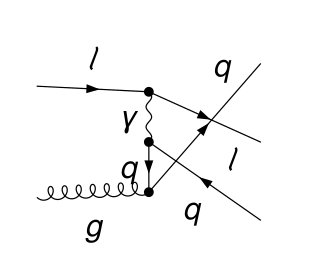
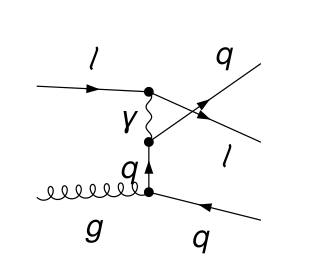
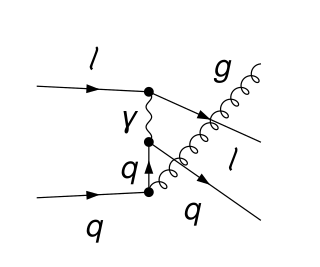
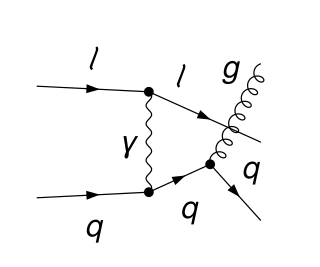
There is no Born term, so the finite coefficients contain only the regular part $c_{\rm reg}(v,w)$, with $P=\alpha_{\rm em}^2\alpha_s C_F e_q^2/(\pi s v w)$ for $\ell\,q\to g$ and $P=\alpha_{\rm em}^2\alpha_s T_R e_q^2/(\pi s v w)$ for $\ell\,g\to q$ (invariants and scales as for lepton–quark scattering). The collinear counterterm is the fragmentation $q\to g$ of the Born quark or the parton distribution $g\to q$, and the photon-in-lepton subtraction uses the photon Born processes.
Checks
Exact agreement with Hinderer, Schlegel and Vogelsang (2015, 2017), unpolarized and polarized, in all three algebra routes.
Files
Processes/LeptonOffDiagonal · Coefficients/LeptonOffDiagonal.wl